In Jamaica, most of us understand what someone means when they say a house or piece of family land is “dead lef.”
The owner died. Nobody completed the legal paperwork. Relatives continued living there, paying the property taxes, repairing the house or building additional rooms. Years passed, and everyone assumed the land belonged to the family.
Then someone tries to sell it, divide it, borrow against it or apply for development approval.
That is when the family discovers that the deceased person is still listed as the registered owner and nobody currently has the legal authority to deal with the property.
“Dead lef” is not an official Jamaican legal term. It is a cultural expression for a very real problem: property left unresolved after its owner dies.
Fixing that problem requires more than a family discussion. The family must determine how the land was owned, who has authority to administer the estate and what must be done to update the Certificate of Title.
Related IBJ guide: Understanding Family Land in Jamaica: What Overseas Jamaicans Need to Know
What Does “Dead Lef” Actually Mean?
Families commonly use “dead lef” to describe property that was left behind when someone died but was never formally transferred to the people entitled to inherit it.
This can happen when:
- The owner died without leaving a will.
- A will exists, but nobody applied for probate.
- The estate received probate, but the title was never updated.
- Several generations died without administering the previous estates.
- Relatives relied on verbal promises instead of legal documents.
- The family cannot find the original title or important records.
- Beneficiaries disagree about who should control or receive the land.
- Everyone assumed paying the taxes meant the ownership problem was handled.
The property does not disappear. The difficulty is that the person named on the title is deceased, while the relatives using the property may not yet have legal authority to sell, transfer or mortgage it.
Start With the Certificate of Title
Before deciding that the family needs probate, the first step is to find out exactly how the deceased person held the property.
The National Land Agency’s guidance on recording an owner’s death explains that the required process depends on the ownership recorded on the Certificate of Title.
| What the title shows | What usually happens after death |
|---|---|
| Sole registered owner | The estate usually requires a personal representative and a Transmission Application. |
| Tenants-in-common | The deceased person’s individual share passes through their estate. |
| Joint tenants | The deceased joint tenant’s interest normally passes to the surviving joint tenant through survivorship. The death is noted on the title. |
| Life tenant | The remainder beneficiaries may apply to note the life tenant’s death, depending on the title and surrounding circumstances. |
This distinction matters.
Two names appearing on a title does not automatically tell you what happens after one owner dies. The title must show whether they owned the property as joint tenants or tenants-in-common.
Joint tenants
Joint tenants have a right of survivorship. When one joint tenant dies, that person’s interest normally passes to the surviving joint tenant or tenants.
The survivor generally applies to have the death noted on the title. This process is different from transferring the share of a deceased tenant-in-common through an estate.
Tenants-in-common
Tenants-in-common own separate shares in the property. When one dies, that person’s share becomes part of their estate.
The share does not automatically pass to the other registered owner. It is distributed under the deceased person’s valid will or Jamaica’s intestacy laws when there is no will.
Practical first step: Obtain a current title search instead of relying on family memory or an old copy of the title. Property documents can be requested online through eLandJamaica.
Why This Happens to So Many Jamaican Families
Most “dead lef” situations do not begin with bad intentions. They begin with delay and assumptions.
A parent may tell one child, “The house is yours when I am gone.” Everyone may hear it and agree. But a verbal promise does not update a registered title.
Another relative may take responsibility for the property taxes and repairs. The rest of the family may begin referring to that person as the owner. Yet their name never legally replaces the deceased person’s name.
Some families are grieving and cannot face estate paperwork immediately. Others fear the expense, expect disagreement or believe the process will be too difficult from overseas.
The danger is that a manageable estate can become far more complicated with time. Beneficiaries may die, move away, lose contact or leave behind children of their own. The family may eventually have to resolve several connected estates before it can resolve the original property.
Probate and Administration, Explained Simply
The estate needs someone with legal authority to act for the deceased owner. That person is called a personal representative.
The type of court grant normally depends on whether there is a valid will and an executor able to act.
If there is a valid will
The executor named in the will generally applies for a Grant of Probate.
Probate confirms the executor’s authority to administer the estate. The executor must still complete the necessary land-registration steps. The will alone does not change the Certificate of Title.
If there is no will
An eligible person generally applies for Letters of Administration.
The court appoints an administrator to identify the estate’s assets and debts and distribute the remaining property according to Jamaica’s intestacy laws.
The relatives do not simply decide among themselves who legally inherits the land. Jamaica’s Intestates’ Estates and Property Charges Act determines the beneficiaries and their entitlements.
If the executor cannot or will not act
A valid will may exist even though the named executor has died, renounced the appointment or is unable to serve.
In that situation, the court may issue Letters of Administration with the Will Annexed to an appropriate administrator. This is different from ordinary probate and should be handled with guidance from a Jamaican estate attorney.
Which court handles the application?
Probate and administration applications may be handled through a Parish Court or the Supreme Court of Jamaica, depending on factors such as the estate’s value and whether the matter is contested.
Because monetary limits and court procedures can change, the family should confirm the correct filing court before preparing an application.
Probate Is Not the Final Land-Transfer Step
Obtaining probate or administration does not automatically place a beneficiary’s name on the title.
When the deceased was the sole registered owner or a tenant-in-common, the executor or administrator normally applies to the National Land Agency to be registered through a Transmission Application.
The NLA describes transmission as placing the personal representative “in the shoes” of the deceased registered owner. The representative can then take the appropriate legal steps to transfer the property to beneficiaries or sell it for the estate.
The NLA lists requirements that may include:
- The Transmission Application
- Grant of Probate or Letters of Administration
- The property description shown on the title
- The deceased owner’s name and date of death
- The property’s value at the date of death
- A Stamp Commissioner’s Certificate, Form 8
- The duplicate Certificate of Title
- Applicable registration fees
- An explanation of any name differences across the title, death certificate and court grant
The required documents depend on the estate and title. This is one reason families should not rely on a generic form downloaded online without first confirming the correct procedure.

What Jamaicans Overseas Need to Know
Living abroad does not prevent you from inheriting Jamaican property.
Many early steps can be completed without flying to Jamaica. An overseas family member may be able to:
- Request a current title search online.
- Consult a Jamaican probate or property attorney remotely.
- Gather identity, relationship and estate documents.
- Apply for a Jamaican TRN from overseas.
- Sign permitted documents before an authorized overseas witness.
- Use a properly prepared Power of Attorney for authorized actions in Jamaica.
- Mail original documents to the attorney or agency handling the matter.
However, families should not assume every estate can be completed entirely remotely. Court disputes, missing originals, competing claims, identity discrepancies and special filing requirements can change what is necessary.
Applying for a TRN from overseas
A Jamaican Taxpayer Registration Number may be required for estate, tax and land transactions.
Merely being mentioned as a beneficiary does not necessarily mean the person immediately needs a TRN. It may become necessary when the beneficiary is receiving title, signing conveyance documents or participating in another formal Jamaican transaction.
Tax Administration Jamaica permits overseas individuals to apply using a completed application and a properly certified copy of acceptable identification. Current instructions should be checked directly through TAJ’s TRN guidance before mailing documents.
Related IBJ guide: How Jamaicans Abroad Can Apply for a TRN From Overseas
Signing documents outside Jamaica
The NLA requires land instruments to be signed manually in ink. Photocopied or facsimile signatures are not accepted for these instruments.
Its signing and witnessing guidance identifies who may witness documents outside Jamaica and what certification or official seal may be required.
An Apostille may also be relevant when a public document is being used between countries participating in the Hague Apostille Convention. However, an Apostille does not replace every signing, witnessing or document-specific requirement.
Before signing anything, ask the Jamaican attorney or receiving agency:
- Who is authorized to witness this particular document?
- Does it need notarization?
- Is an Apostille required?
- Is additional proof of the notary’s authority required?
- Must the original wet-signed document be sent to Jamaica?
That is safer than signing first and discovering later that the document cannot be accepted.
Foreign probate grants
A probate or administration grant issued overseas cannot simply be presented as though it were issued in Jamaica.
It may need to be formally recognized through a process called resealing before it can be used to deal with Jamaican assets. The Probates (Re-Sealing) Act governs this process.
Whether a particular foreign grant qualifies and what supporting documents are required must be confirmed for that grant. A Jamaican estate attorney should review it before the family begins a land transfer.
Common Myths That Keep Family Land Frozen
“I paid the property taxes, so the land belongs to me.”
Paying property taxes does not make someone the registered owner.
Jamaican property tax can be paid by someone in possession of the land, including an owner, occupier or mortgagor. A tax receipt may show that you made a payment, but it does not automatically transfer the title.
“I paid the light and water bills.”
Utility accounts show who paid for or used a service. They do not determine who owns the land.
“I built rooms on the house, so I own my section.”
Paying for construction does not automatically create a registered share in the land. Those expenses may become evidence in a financial or legal dispute, but they do not update the Certificate of Title.
Building on unresolved family land can leave a person investing significant money in property they do not legally control.
“Grandma told everyone the house was mine.”
A verbal promise may be emotionally important, but it does not replace a valid will, court grant or registered transfer.
Depending on the facts, someone may claim that a promise and their reliance on it created an equitable interest. That would be a separate legal claim requiring evidence. It should not be assumed.
“Everyone agrees, so we can sell it.”
Agreement can make the process easier, but family consensus alone does not authorize the sale of land registered in a deceased person’s name.
The person signing the sale documents must have legal authority to act for the estate.
“All the siblings must agree before probate can begin.”
Not necessarily.
An executor named in a valid will may apply for probate without obtaining every beneficiary’s permission. A person who objects can use formal court procedures, including entering a caveat where appropriate.
Where there is no will, the right to apply for administration and any required consents depend on the family structure and applicable court rules.
What Happens If Nothing Is Done?
The family may continue occupying and maintaining the property, sometimes for decades. But unresolved ownership limits what can be done legally.
Without an authorized personal representative and the proper title process, the family may be unable to complete a lawful:
- Sale
- Transfer to a beneficiary
- Mortgage
- Subdivision
- Long-term lease
- Use of the property as security
- Development or other transaction requiring proof of ownership
Delay also increases the risk of:
- Missing documents
- Unpaid taxes and other estate liabilities
- Name discrepancies
- Unauthorized construction
- Competing family claims
- Fraudulent attempts to deal with the land
- Beneficiaries dying before receiving their interests
- Several estates having to be administered in sequence
A property that began with one deceased owner and three children can eventually involve grandchildren, great-grandchildren and the estates of family members who have also died.
That is how “we will sort it out later” becomes a multi-generation legal problem.
How to Start the Process From Abroad
Do not begin by asking the family who they think owns the property. Begin with the records.
Initial document checklist
Gather as many of the following as possible:
- Certified death certificate
- Original will and any codicils
- Copy or reference details for the Certificate of Title
- Property address, parish, volume and folio numbers
- Current title search
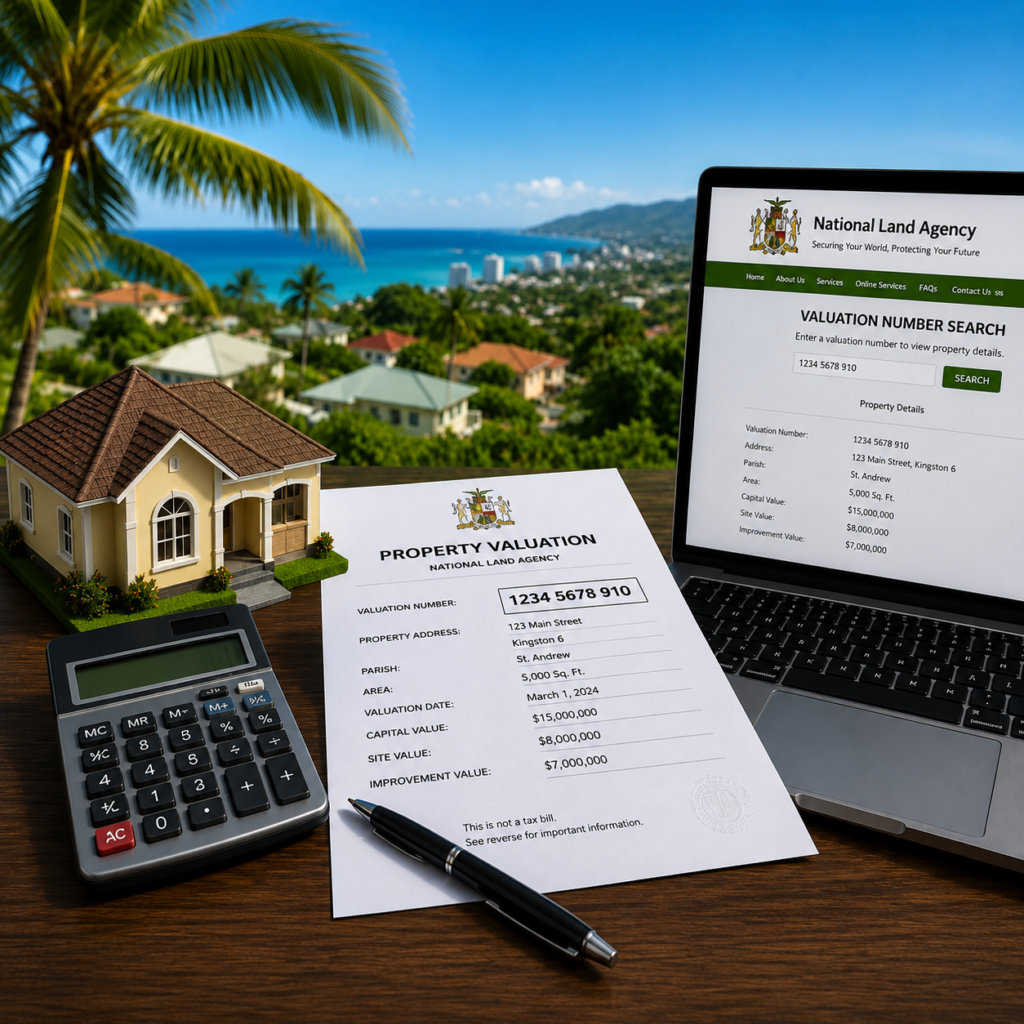
- Property-tax valuation number and receipts
- Deceased owner’s TRN, if available
- Applicant’s identification and TRN
- Names and contact details for executors and potential beneficiaries
- Birth and marriage certificates proving family relationships
- Death certificates for beneficiaries who died after the original owner
- Information about mortgages, caveats, leases or other interests
- Foreign probate or administration grant, if one already exists
- Records showing any differences in the deceased person’s name
A sensible starting order
- Obtain a current title search.
- Confirm the ownership structure shown on the title.
- Determine whether a valid will exists.
- Identify the appropriate executor or proposed administrator.
- List the deceased person’s assets, debts and likely beneficiaries.
- Speak with a Jamaican probate or property attorney.
- Confirm the correct court and estate application.
- Ask for document-signing instructions before notarizing anything overseas.
- Complete probate, administration or foreign-grant resealing as required.
- Complete the NLA process to note the death or register the personal representative on transmission.
You do not need every answer before starting. You do need accurate records before the family makes decisions about selling, dividing or building on the land.
Frequently Asked Questions
Can I handle dead-lef property without flying to Jamaica?
Many steps can be handled from overseas with a Jamaican attorney, properly witnessed documents and, where appropriate, a Power of Attorney. Whether travel is necessary depends on the estate, court requirements, documents and any disputes.
A Power of Attorney does not replace probate or Letters of Administration. It only authorizes someone to perform specified actions on another person’s behalf.
What if there is no will?
An eligible person may apply for Letters of Administration. The estate is then distributed under Jamaican intestacy law, not according to informal family preferences.
What if siblings disagree?
Disagreement does not always prevent the estate from moving forward. However, a beneficiary may object, enter a caveat or ask the court to intervene. Contested matters should be handled by a Jamaican estate attorney.
What if one beneficiary cannot be found?
The personal representative must make reasonable efforts to identify and locate beneficiaries. Missing beneficiaries can delay distribution and may require searches, court directions or involvement from the Administrator-General’s Department.
How long does the process take?
There is no dependable universal timeline. Complete and uncontested matters generally move more smoothly. Missing documents, foreign grants, disputes, multiple unadministered estates and title problems can cause substantial delays.
What if the original title is missing?
The NLA has a separate process for replacing a lost or destroyed duplicate Certificate of Title. This can add time and documentary requirements to the estate process.
Island Breeze Perspective
“Dead lef” is rarely just a paperwork problem.
It carries grief, old promises, sibling tension and sometimes guilt because the family knows the matter should have been handled years ago.
But shame will not clear a title.
The best time to organize a will, confirm how the land is owned and tell the family where the documents are kept is while the owner is alive and able to make decisions. The next best time is now, before another generation becomes attached to land that nobody has the authority to manage.
Starting the process does not mean the family must sell the property. It means the family is protecting its ability to keep it, improve it, transfer it properly or make a different decision later.
Gentle urgency is still urgency. Find the title. Locate the will. Gather the death certificates. Get qualified advice. Take the first legal step before the family’s history becomes even harder to untangle.
Final Thoughts
Family land can carry memories, identity and sacrifice. But emotional ownership and legal ownership are not the same thing.
If a property is still registered in the name of someone who died, do not rely on tax receipts, utility bills or verbal promises. Check the title, identify the correct estate process and get the ownership records updated.
The longer the family waits, the more people, documents and unresolved estates may become involved.
Start while the facts can still be found and the people who know the history are still here to explain it.
This article provides general information and is not legal advice. Probate, administration, resealing and land-registration requirements depend on the particular estate. Consult a Jamaican attorney-at-law and confirm current requirements with the relevant court, Tax Administration Jamaica and the National Land Agency.